

GPU & LLM Inference Infrastructure Design and Build Advisory
GPU selection, inference optimization, distributed serving, and cloud vs. on-premises
You are not sure whether a GPU quote is reasonable. Environment setup is stuck on an RTX 5090 with CUDA and driver issues. You cannot decide between cloud GPUs and on-premises. Questions about the infrastructure that runs LLMs range from hardware selection to environment trouble.
We operate our own GPU cluster and have gone from building GPU machines to constructing and running our own GPU data center. As technical advisors we provide decision material grounded in that operational experience: GPU selection and configuration design, inference engine comparison, distributed processing, cost optimization across cloud and on-premises, research workstation procurement, and compatibility across CUDA, PyTorch and GPU generations.
LLM Infrastructure
From GPU Environment Design to Distributed Inference
Infrastructure that doesn't just "work" but "scales."
Production LLM operations require proper GPU selection, memory management, inference optimization, and load balancing. We support optimal infrastructure design and construction from single GPU servers to large-scale GPU clusters, tailored to your requirements.
Technical Domains
GPU Infrastructure Design
- GPU selection (H100/A100/L40S)
- Server configuration design
- Network design (NVLink/InfiniBand)
- Storage design
Inference Optimization
- Quantization (GPTQ/AWQ/GGUF)
- vLLM/TGI utilization
- Batch processing optimization
- KV cache management
Distributed Processing
- Tensor/Pipeline parallelism
- Multi-GPU inference
- Multi-node clusters
- Load balancing design
Cloud/On-Premise
- AWS/GCP/Azure GPU utilization
- On-premise GPU server setup
- Hybrid configurations
- Cost optimization
Past Support Examples
We have extensive experience from GPU cluster construction to inference environment optimization.
Consulting Firm
- GPU server/cluster configuration estimation support
- Optimal configuration proposals based on budget and requirements
Startup
- GPU server design support for high-load environments
- Optimization balancing inference performance and cost
System Vendor
- Internal local LLM environment setup support
- Inference infrastructure construction using vLLM
Qualiteg's Strengths
In-House GPU Infrastructure Operations
We operate our own GPU cluster with NVIDIA H100/A100, and can share insights gained from real-world operations directly.
Hardware to Software
We provide integrated support from hardware-level GPU selection and server configuration to inference engine settings like vLLM and TGI.
Cost Optimization Expertise
We can propose solutions considering TCO (Total Cost of Ownership), including appropriate use of cloud GPU, on-premise GPU, and inference APIs.
Related Resources
Explore our LLM Inference Infrastructure Provisioning course on the Qualiteg Blog.

TensorRT 10 × Blackwell Migration Guide (Part 3): Passing 5D grid_sample Through a Custom Plugin
How to pass 5D grid_sample — which TensorRT 10 rejects natively — through a custom plugin: building for Blackwell, rewiring ONNX nodes, and the fp16 precision pitfall, all verified with measurements.

TensorRT 10 × Blackwell Migration Guide, Part 2 — A Successful Build Doesn't Mean Correct Results: Five Cases of Silent Degradation
Five real cases where a TensorRT 10 build succeeds but output quality silently degrades — how to isolate the causes and verify correctness.

TensorRT 10 × Blackwell Migration Guide, Part 1 — When Your Inference Assets Stop Working on RTX 50: Fundamentals and the First Hurdles
Why existing TensorRT inference assets break on the RTX 50 (Blackwell) generation, and the fundamentals and first hurdles of migrating to TensorRT 10.

KVキャッシュのオフロード戦略とGQAの実践的理解
Strategies for offloading KV cache from GPU VRAM to CPU RAM and disk, plus GQA (Grouped-Query Attention) for dramatically reducing KV cache size.

The Reality of LLM Training: From GPU Selection to Cost Analysis
Real-world GPU requirements and costs for LLM training with examples from LLaMA 2 and DeepSeek-V3.

The Overlooked CPU Bottleneck in Multi-GPU Systems and How to Fix It with taskset
Why parallel GPU processes slow down with no GPU contention — identifying CPU-bound stages and pinning cores with taskset.

Is Your Code Running on CPU Instead of GPU? ~ONNX Runtime cuDNN Warning Fix~
How to resolve the "libcudnn.so.9" error when running GPU inference with ONNX Runtime.
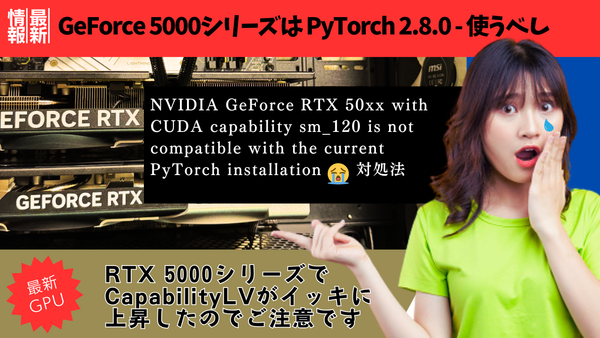
Fixing 'NVIDIA GeForce RTX 50xx with CUDA capability sm_120 is not compatible' in PyTorch
The cause of the sm_120 incompatibility error on Blackwell GPUs and how to set up your PyTorch environment correctly.

Async-ifying Heavy CUDA Work in PyTorch Caused a Memory Leak — Here's the Fix
How a simple async/await refactor exhausted GPU memory, and the mechanism and solution behind it.

LLM Inference Provisioning Part 5: From GPU Node Configuration to Load Testing
Covers GPU node configuration, load testing, trade-off considerations, and real server examples.

LLM Inference Provisioning Part 4: Selecting Inference Engines
Compares inference engines like vLLM and TGI, explaining selection criteria.

LLM Inference Provisioning Part 3: Estimating Model Inference Memory Consumption
Explains GPU memory consumption factors including model footprint and KV cache.

LLM Inference Provisioning Part 2: Estimating LLM Service Request Volume
Learn how to estimate expected request volume for calculating required GPU nodes.

LLM Inference Provisioning Part 1: Basic Concepts and Inference Speed
Explains the fundamental concepts and inference speed considerations for building LLM inference infrastructure.
When Your GPU Service Hits a Segmentation Fault — A Practical Approach from Analysis to Resolution
Diagnosing a once-in-hundreds-of-restarts segfault that could take down an entire GPU service.

Optimal GPU Server Capacity Calculation: Queuing Theory and Practical Models
Learn how to calculate maximum user support capacity for GPU servers using queuing theory.
2025 NVIDIA GPU Quick Search Tool
Search and filter NVIDIA GPUs by generation and specs: Blackwell, Hopper, Ada Lovelace, and more.

[ChatStream] GPU Server Configuration for Large LLM Inference
Video explanation of GPU server/cluster configuration for large LLM inference using Llama3-70B as example.

Speculative Decoding: Accelerating LLM Inference Speed
A technique to speed up inference by using a small model to predict ahead, reducing computation load on larger models.
Frequently Asked Questions
We want to decide whether cloud GPUs or on-premises is right for us.
We compare on usage pattern and cost. For GPU use on AWS/GCP/Azure, on-premises GPU servers, and hybrid setups combining both, we present a TCO comparison and the configuration that fits your requirements. We also evaluate GPU server proposals from vendors.
Our PyTorch environment setup is stuck on the latest GPU. Can you help us isolate the problem?
Yes. We help isolate and resolve environment issues across CUDA, cuDNN and driver configuration, compatibility between PyTorch, CUDA and GPU generations, and support for RTX 50 / Blackwell (sm_120). Our blog publishes a measured migration guide for TensorRT 10 and Blackwell.
We want inference to run faster and cheaper. Where do we start?
We verify the effect in order: quantization such as GPTQ/AWQ/GGUF, using vLLM or TGI, batch optimization, and KV cache management. Where needed we design multi-GPU and multi-node inference with tensor and pipeline parallelism and load balancing.
We want to choose a GPU workstation for research and PoC.
We design the configuration for your research or PoC goals: choosing between RTX-class and professional GPUs, comparing self-build with vendor procurement, and optimizing power, cooling, expandability and budget. We also estimate the GPU configuration and cost needed for LLM training and inference.
CONTACT
Contact Us
For questions or consultations about AI Technology Consulting,
please feel free to contact us.