

Natural Language Processing & Japanese PII Detection Advisory
Japanese-specific detection and masking, from honorific names and Japanese addresses to context-dependent amounts
You deployed a multilingual PII detection tool, yet it cannot recognize "Yamada-bucho" as a person, misses addresses with notation variants, and cannot tell "annual income 5 million yen" from "revenue 5 million yen". Japanese PII detection has difficulties that tools from English-speaking markets do not see.
Our team has researched natural language processing for many years and holds technologies for every combination of purpose, accuracy and speed, from classic morphological analysis and named entity recognition (NER) to the latest Transformers and LLMs. Based on our own corpus and understanding of Japanese, we productized a Japanese-only PII detection and masking engine. We provide that technology as technical advisors, adapted to your documents and workflows.
NLP/Natural Language Processing
Japanese-Specialized Advanced Text Processing & PII Detection
Embracing the depth and complexity of the Japanese language.
Global NLP tools are primarily designed for English-speaking regions and often fail to adequately handle Japanese-specific complex writing systems and context-dependent semantics. We have a team of experts who have been researching natural language processing for many years, with a wide range of technologies from morphological analysis using established libraries (MeCab/Sudachi) and NER (spaCy/GiNZA/CRF) to the latest BERT and LLM, covering different use cases, precision requirements, and speed demands. Armed with our proprietary original corpus and deep understanding of Japanese cultural context, we have achieved productization and practical implementation as a PII detection engine. We deliver truly practical NLP solutions for Japanese businesses.
The Beauty and Complexity of Japanese — And Qualiteg's Approach
Addressing the complexity of Japanese requires a well-balanced combination of rule-based heuristic methods and machine learning/deep learning approaches. Our strength lies in deeply understanding both technologies and being able to select and integrate the optimal methods for each challenge.
A Rare Multi-Layered Writing System
Hiragana, Katakana, Kanji, Roman letters, and numbers combine organically to create rich expressiveness. A single company name can be written as "株式会社国際情報技術研究所", "KJK研究所", or "ケージェーケー研究所"— this flexibility is a strength of Japanese but also makes computer processing challenging.
Context Determines Meaning
"三沢から連絡がありました" (Misawa contacted us)—Is this a person's name? Company? Place name? In Japanese, this cannot be determined without context. In English, "Mr. Misawa" (person) and "Misawa City" (place) are clearly distinguished, but Japanese requires examining broader context.
Information from the Honorific System
"山田が来ました", "山田さんが来ました", "山田様がいらっしゃいました", "山田先生がお見えになりました"— the type of honorific helps determine a person's status and required masking level. Honorifics contain multi-layered information about relationships and social standing.
Technical Domains
PII Detection
- Japanese-specialized PII detection engine
- Honorific-driven name detection
- Full support for Japanese address formats
- Phone/email pattern detection
- Context-aware high-precision detection
Named Entity Recognition (NER)
- Person/organization/location identification
- Japanese context enhancer
- spaCy/GiNZA utilization
- CRF/BiLSTM-CRF models
- Transformer-based deep learning
Morphological Analysis
- MeCab/Sudachi/Janome utilization
- Custom dictionary construction
- POS-based context judgment
- Dependency parsing
- Technical terms & neologisms support
Text Masking & De-identification
- Staged PII masking
- Safe processing before LLM use
- Multiple file formats (PDF/Excel/PPT)
- Hidden information detection
- Reversible & irreversible masking
Processing Levels: Precision vs Speed Tradeoffs
In real business scenarios, the balance between speed and precision must be flexibly adjusted based on use case, purpose, and security requirements. We propose optimal processing levels across 5 tiers based on data importance.
Ultra-Fast Scan
10K+/secHigh-speed pattern matching with regex. Instantly detects clearly formatted information like phone numbers, email addresses, and credit card numbers.
Balanced Mode
1K+/secMorphological analysis engine + rule-based inference. Understands Japanese grammar structure with POS-based context judgment.
High-Precision NER
100+/secspaCy/GiNZA + CRF/BiLSTM-CRF. Advanced named entity recognition via machine learning with flexible judgment considering entire sentence structure.
Transformer Deep Learning
100/secRoBERTa/DeBERTa Japanese models. Deep understanding of entire document context, inferring long-range dependencies and implicit information.
LLM Integration
10/secLarge Language Model integration. Human-level language understanding that comprehends abbreviations, jargon, and implicit references, proposing appropriate masking.
Consultations We Handle
- Global tools have insufficient Japanese detection accuracy, requiring additional development costs
- Need to safely remove personal information before inputting internal data to LLMs
- Want to automatically extract and mask specific information from contracts and meeting minutes
- Need high-precision Japanese text classification, summarization, and sentiment analysis
- Want to auto-classify and route customer support inquiries
- Need accurate extraction of names, organizations, and product names from internal documents
- Need PII detection that handles Japan-specific address formats (Kyoto street names, etc.)
Our Expertise
With deep expertise in Japanese NLP technology and hands-on experience developing and operating PII detection/masking products, we can share the following specialized knowledge.
Japanese-Specialized Detection Logic
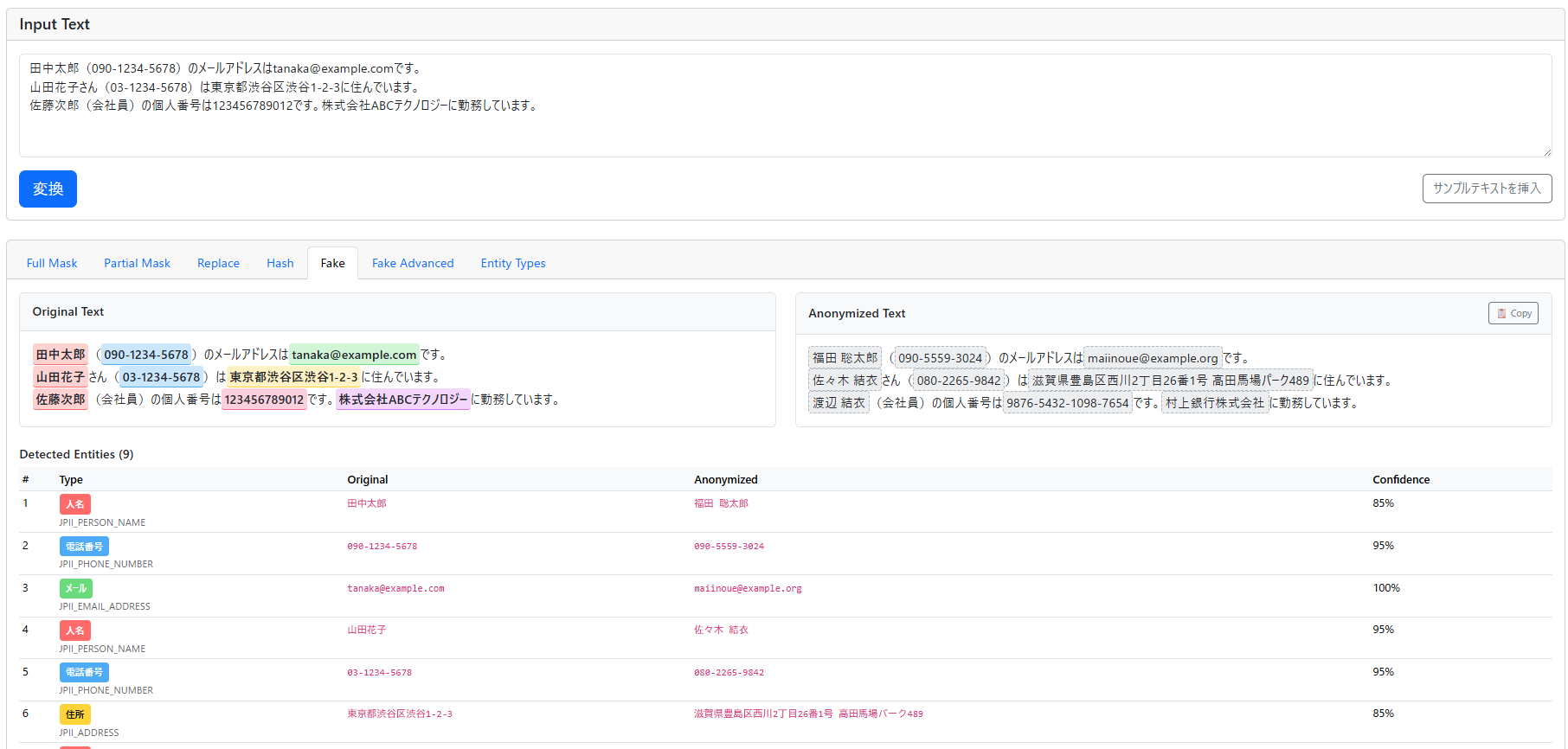
Honorific-driven detection (identifying names using "様" or "さん" as cues), hierarchical pattern matching for address detection, and other techniques leveraging Japanese cultural characteristics.
Multi-Layer Filtering Technology
Morphological filtering, statistical filtering (surname/given name database matching), contextual filtering, and exclusion list application—composite approaches that improve precision.
Optimization Technology Application
Model size reduction through quantization, improved GPU efficiency via dynamic batching, lightweight model creation through knowledge distillation—achieving "high precision yet lightweight."
Qualiteg's Strengths
Years of Research & Expert Team
Our team includes specialists who have been researching NLP for many years. From morphological analysis and NER using established libraries to the latest Transformer/LLM technologies, we understand the evolution and propose optimal solutions.
Original Corpus & Productization
We possess proprietary Japanese corpora and have achieved productization as a PII detection engine. We have not just theory, but implementation capabilities proven in production environments.
Heuristics × Machine Learning Fusion
Japanese complexity requires both meticulous rule-based approaches and deep learning generalization. We deeply understand both and optimally combine them for each challenge.
Full-Stack Technology Coverage
From morphological analysis using established libraries (MeCab/Sudachi), NER (spaCy/GiNZA/CRF), to BERT/RoBERTa/DeBERTa and LLM—we provide comprehensive technologies matching your precision and speed requirements.
Deep Understanding of Japanese
We develop technology with deep understanding of Japanese cultural background, business practices, and linguistic structure. We achieve precision that sets us apart from global tools that merely "support Japanese."
Flexible Level Design
We propose optimal approaches from 5 processing levels based on use case, budget, and security requirements—preventing cost increases from excessive precision pursuit.
LLM-Audit
"LLM-Audit" is a comprehensive security solution for auditing enterprise LLM usage. It enables bidirectional auditing—monitoring both outbound (employee to LLM) and inbound (LLM to employee) communications. With protection against prompt injection, jailbreak attack defense, and harmful content detection/blocking, it strengthens security and compliance for enterprise AI adoption.
Qualiteg-PII-Detector
"Qualiteg-PII-Detector" is our Japanese-specialized PII detection engine integrated into LLM-Audit. It condenses years of our NLP technology expertise to enable high-precision personal information detection and masking before LLM input. It also supports detection of "hidden PII" in various file formats including PowerPoint, Excel, PDF, and images. This productized PII detection engine is proof of our Japanese NLP technical capabilities.
Related Resources
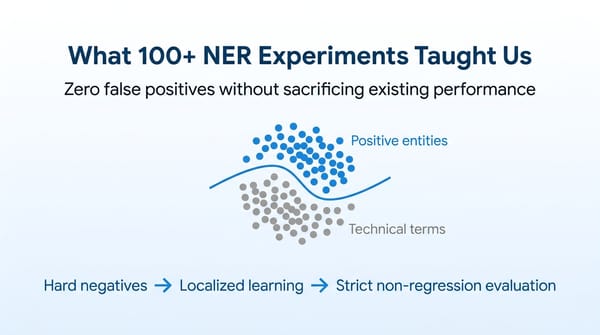
Why Zero False Positives Still Wasn't Enough: Lessons from 100+ NER Experiments
How we eliminated false positives in our NER model through hard-negative mining, knowledge distillation, and per-entity score adjustments — across 100+ experiments without regressing existing performance.
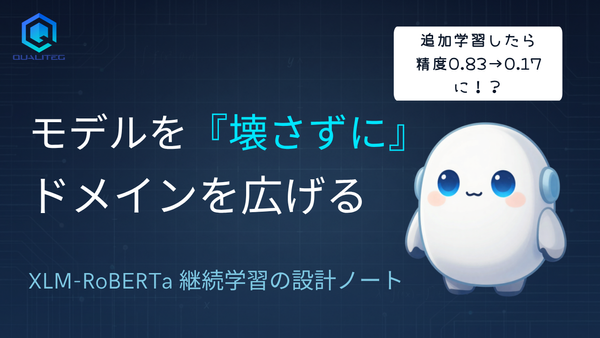
Expanding Domains Without 'Breaking' the Model — Design Notes on Continual Learning for XLM-RoBERTa
Precision collapsed from 0.83 to 0.17 after naive fine-tuning — how we designed continual learning for our PII detection engine.
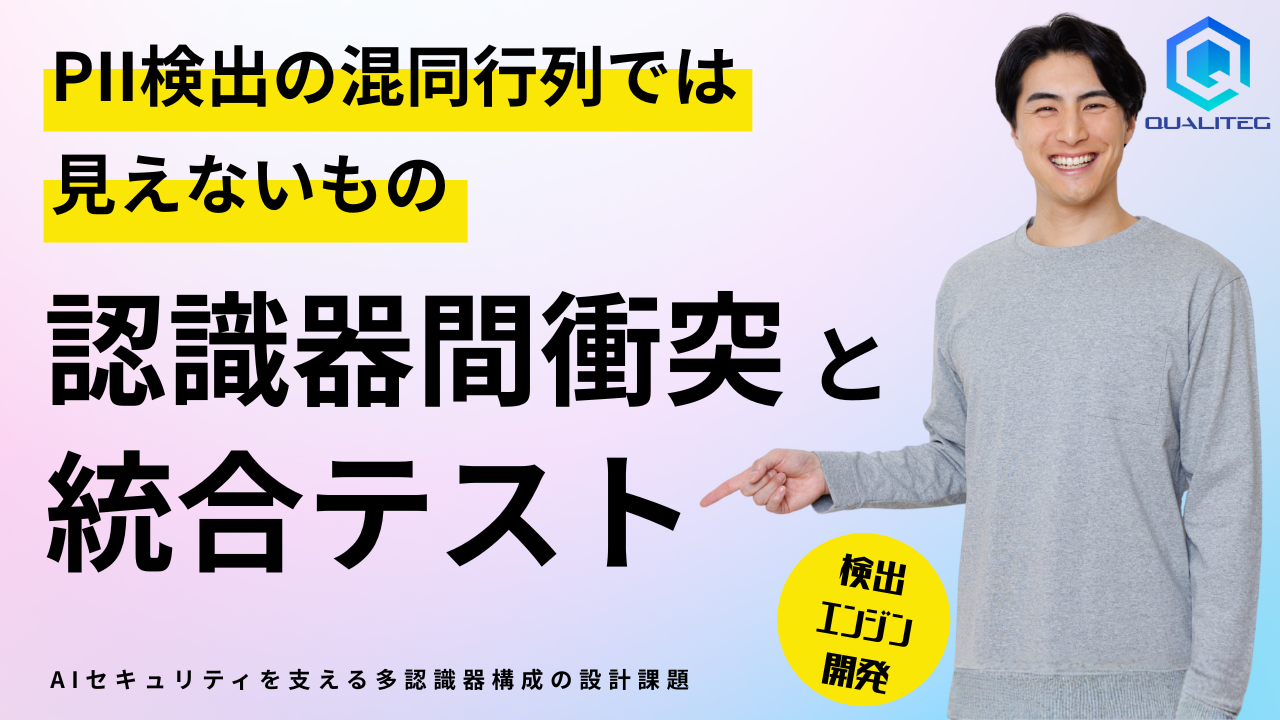
PII検出の混同行列では見えないもの ― 認識器間衝突と統合テスト
Explaining the cross-recognizer collision problem in PII auto-detection and how to design integration tests to detect it.
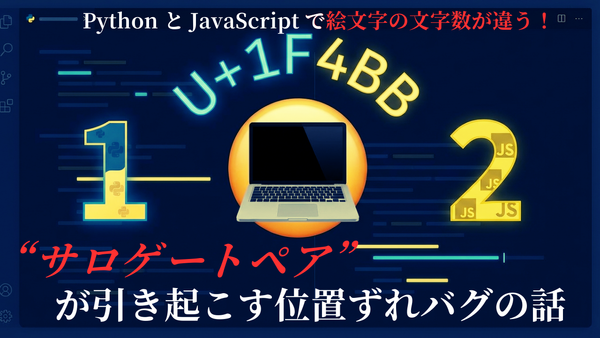
Emoji Length Differs Between Python and JavaScript! Position-Shift Bugs Caused by Surrogate Pairs
A PII-highlighting bug traced to how Python and JavaScript count characters differently in surrogate-pair territory.

High-Precision PII Detection Technology — Embracing the Depth of Japanese Language
Coexistence of global tools and Japanese-specialized solutions. Deeply embracing Japanese unique writing systems and cultural context to deliver practical PII detection for Japanese enterprises.
Frequently Asked Questions
Our existing multilingual tool does not detect Japanese PII accurately enough. What is different?
Honorific-driven person name detection, support for the Japanese address system, and context-aware judgment. By learning context patterns from large document sets we achieve semantic-level decisions such as distinguishing "annual income" from "revenue" for the same figure.
We want to mask personal information safely before feeding internal data to an LLM.
We support five de-identification methods including substitution, masking and hashing, plus reversible pseudonymization that can be restored. We design the integration into your existing DLP, SIEM and LLM workflows as well.
Should we prioritize speed or accuracy?
It depends on purpose and sensitivity. We offer five levels, from ultra-fast regex scanning (Level 1) through context analysis pipelines, high-accuracy NER and Transformer-based wide-context understanding to an LLM-integrated mode (Level 5), and propose the level that matches the data: Level 1 for log analysis, Level 5 for board minutes and critical contracts.
Can you also extract specific information from contracts and meeting minutes?
Yes. Through identification of person, organization, place and product names, context judgment using dependency parsing and part-of-speech information, and custom dictionaries for technical terms and neologisms, we support information extraction and masking from contracts and minutes.
CONTACT
Contact Us
For questions or consultations about AI Technology Consulting,
please feel free to contact us.